
For decades, drag lived where the lights were low: in clubs, on late-night stages, at balls that outsiders rarely saw. In 2026, a cluster of exhibitions made the case for drag as fine art, moving the queens out of the barroom and onto the museum wall, complete with wall text, curators and a permanent-collection context.
It is not a single show but a pattern. From a Queens warehouse to an Indianapolis museum’s first-ever fashion commission, institutions spent the year treating drag not as novelty or nightlife spillover, but as a serious, multidisciplinary art form worth collecting and studying.
Inside “Queens: The Art of Drag & NYC”
The most direct statement of intent is in Western Queens. Culture Lab LIC’s exhibition “Queens: The Art of Drag & NYC,” open from June 4 to August 9, 2026, gathers photography, portraiture, costume, video, installation and performance materials into one of the first US shows to frame drag itself as an art practice.
Curated by Tess Howsam and Parker Phillips, the show pulls together work from performers and artists including Benjy Bradshaw, Daniel Dabdoub, the photographer Rachel Rampleman, who holds one of the largest digital archives of drag performance in the country, and fashion designer Kevin Pascual. The breadth is the point: drag is presented as a discipline that borrows from every other one.
One of the show’s voices, Sam Branman, puts the thesis bluntly, calling drag “the primary art form of the 21st century” in the US, especially since 2016. As he frames it, drag “is collage, it is performance, it is dance, it is critique, it is comedy, it is fashion, it is painting” all at once, a Swiss-army-knife of a medium that a single-genre gallery has never quite known how to file.
That difficulty is part of the show’s argument. A drag look is at once a garment, a piece of choreography, a character and a joke, and it usually only exists fully for the length of a number before it is gone. By fixing that ephemerality in photographs, costume and video, the exhibition turns something built to vanish into something a visitor can study up close, which is exactly the move that separates entertainment from an art object in a museum’s eyes.
A Museum’s First Fashion Commission
If the Queens show argues the case with breadth, an Indianapolis exhibition argues it with institutional weight. Diego Montoya’s “Resplendent Dreams: Reawakening the Rococo,” at the Indianapolis Museum of Art at Newfields through March 29, 2026, places his elaborate drag costumes alongside the museum’s permanent Rococo collection.
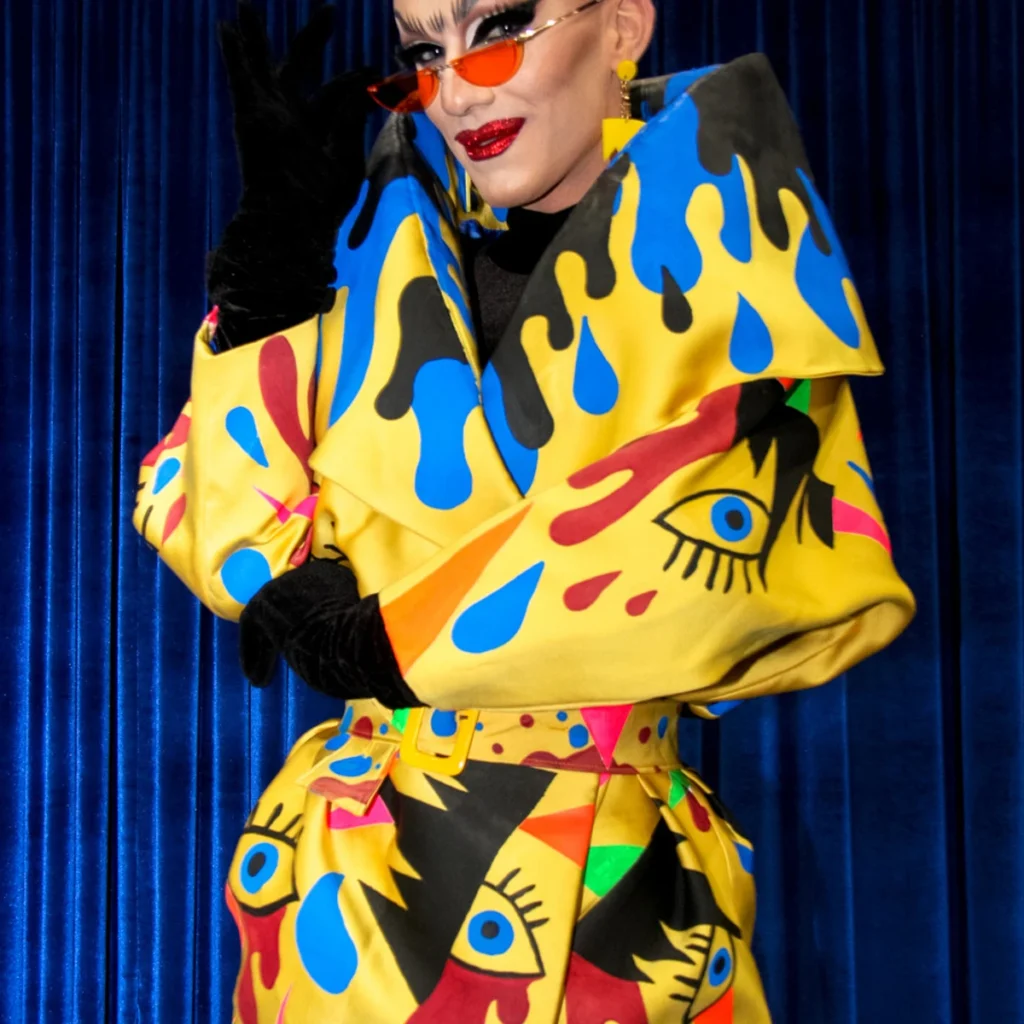
Montoya, a Lima-born, two-time Emmy-winning costume designer, built the pieces for a roster of Drag Race alumni including Sasha Velour, Blair St. Clair, Kandy Muse, Jimbo and Miz Cracker. At the centre is “Rocaille,” a new work made for the show that the museum has described as its first-ever fashion commission, a small but telling milestone for how an art institution categorises this kind of craft.
For Montoya, the framing mattered as much as the display. “To see it treated with such care, and presented with the full resources of the museum, that meant the world to me,” he said, adding that it “gives me hope to see museums beginning to make space for this kind of work and for the communities it represents.”
Why Institutions Are Paying Attention Now
The timing is not accidental. Drag has spent the past decade moving from subculture to mass culture, and the art world tends to follow cultural gravity, if slowly. The Queens show itself nods to that lag, arriving after the Museum of Arts and Design’s 2022 to 2023 drag exhibition and Rampleman’s own 2025 show, each one making the next easier to greenlight.
There is also a defensive logic to putting drag as fine art behind museum glass. As drag has become a flashpoint in political fights, institutional recognition functions as a kind of cultural counterweight, insisting on the form’s seriousness and its heritage at exactly the moment its right to exist in public is being contested. A museum wall is a hard thing to dismiss as a passing trend.
Montoya’s Indianapolis show makes that subtext almost literal. By hanging contemporary drag costume beside eighteenth-century Rococo finery, the exhibition invites viewers to notice how much the two share, in their excess, their theatricality and their delight in ornament, and quietly asks why one has always been called high art and the other has not. It is an art-historical argument disguised as a fashion display.
Drag’s Long Roots in Queer History
Part of what these shows recover is history. The Queens exhibition traces drag back through New York’s ballroom culture and the modern LGBTQ+ rights movement to William Dorsey Swann, a formerly enslaved man widely recognised as the first self-proclaimed drag queen, who hosted balls in 1880s Washington. Framed that way, drag is not a recent entertainment fad but a queer art tradition well over a century deep.
That lineage connects directly to the broader story of how queer celebration and queer protest have always been entangled, a thread this publication has followed in its look at Pride as protest and the radical history behind the party. Putting Swann’s descendants in a gallery is, in its own quiet way, a continuation of that history rather than a departure from it.
Beyond the Museum: Festivals and the Maker Economy
The institutional turn is not confined to museums. In Berlin, the 2026 Drag Festival at Festsaal Kreuzberg pairs a day of performance with a Queer Creators Village, a marketplace built around independent queer makers, fashion designers and visual artists. It is a reminder that the art of drag is also an economy, one of costume-builders, photographers, wig-makers and designers whose labour rarely gets a credit line.
That maker economy is exactly what the gallery shows make visible. When a costume moves from a dressing room to a plinth, the hours of hand-work behind it become legible as craft, and the people who do that work step, however briefly, into the frame usually reserved for the performer alone.
It also widens who gets to claim the label of artist. A photographer like Rampleman, a costume designer like Montoya or Pascual, a performer-designer like Bradshaw: each occupies a role the mainstream art world has historically kept at arm’s length. Grouping them under one roof, and one wall text, is a small act of reclassification, and reclassification is often how art history actually changes.
What the Gallery Moment Means for Drag
None of this replaces the club, and none of the artists involved seem to want it to. The stage remains where drag is made and tested; the gallery is where a slice of it is preserved and argued for. The two can coexist, and 2026 suggested they increasingly will.
What the year’s exhibitions establish is a precedent: that drag can hang next to Rococo portraiture without shrinking, that a costume can be a commission and not just a look, and that the queens have a place in the archive as well as the spotlight. For an art form built on refusing to stay in its assigned box, the museum is simply the latest room it has walked into and made its own.
About The Author