
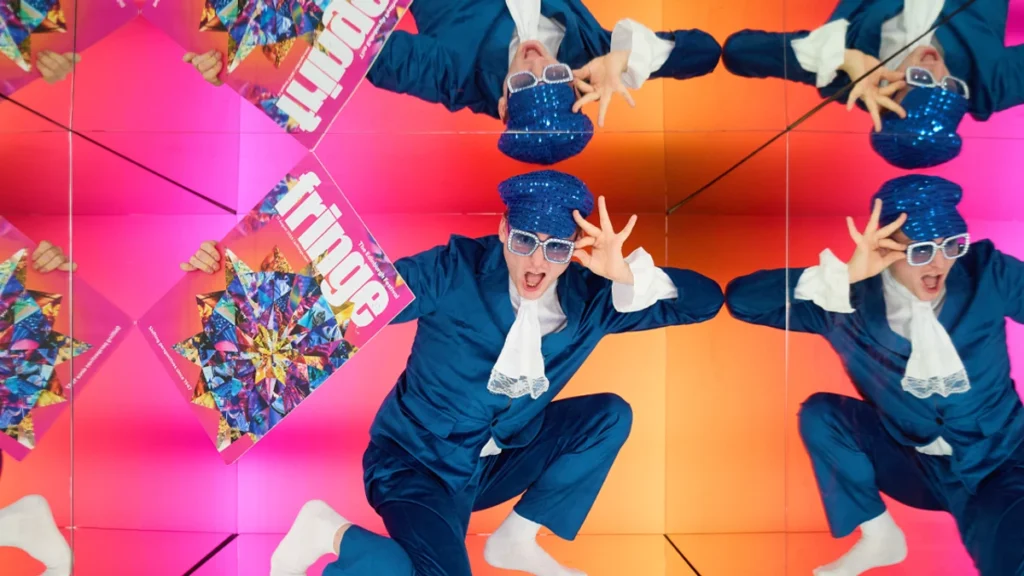
A performer at the launch of the 2026 Edinburgh Festival Fringe programme.
The Edinburgh Fringe 2026 opens on 7 August, and the queer half of the programme is once again far bigger than the handful of shows that will end up in the national reviews. There are 3,649 shows on this year’s bill. Working out which of them are worth your money before the word of mouth kicks in is the whole game.
This is a booking guide rather than a review round-up. Every show below is in the published programme, with the venue and run dates as listed, so you can put a plan together now instead of queueing for returns in week three.
How Big the 2026 Fringe Actually Is
The scale is worth stating plainly, because it explains why a guide is necessary at all. The 2026 programme carries 3,649 shows from 71 countries across 258 venues, adding up to 53,884 individual performances and 1,748 world premieres. Comedy is the largest section at 1,401 shows, or 38.4 per cent of the programme, with theatre second at 1,025.
Tony Lankester, the Fringe Society’s chief executive, noted “a notable increase in artist registrations from overseas” this year and encouraged audiences to “mix it up and explore the unique, creative performances available.” He has also made the practical case repeatedly: “Booking tickets in advance supports the thousands of artists who come to the Fringe every year.”
Cost is less of a barrier than the headline figures suggest. There are 691 Pay What You Want or Pay What You Can shows in the programme, which is where a lot of debut queer work sits.
The thematic spread is worth knowing before you book. Alongside comedy and theatre, the Edinburgh Fringe 2026 programme carries 388 music shows, 168 musicals and operas, 166 cabaret and variety hours, and 155 spoken-word pieces. Queer work turns up across all of those sections rather than clustering in one, which is why a guide organised by genre tends to be more useful than a single list.
Comedy Where Queer Life Is the Material
The strongest queer comedy at the Edinburgh Fringe 2026 is not novelty billing; it is performers using an hour to work through something specific. DIVA’s round-up of shows by queer women and non-binary performers is the fullest guide to that strand of the programme, and several of its picks are among the better-value bookings on the bill.
Rosie Jones brings I Can’t Tell What She’s Saying to the Cabaret Bar at Pleasance Courtyard, running 5 to 30 August at 16:00, taking on dating, disability and, by her own framing, gravy. Amy Matthews returns with Definitions of Toast at O’Neill’s at Monkey Barrel Comedy, 5 to 30 August at 15:00, a show about first queer relationships, self-perception and sobriety, built around the problem of being surrounded by outrage and unable to feel it yourself.
Temi Wilkey’s Lover Girl, Upstairs at Pleasance Courtyard at 14:40, is a useful corrective to a genre that usually runs on dating disasters: it argues for being happily single and for treating yourself as the love of your own life. Hannah Platt’s Cult Classic, in the Attic at Pleasance Courtyard at 19:15, follows an acclaimed debut with an hour on cults, belonging, and finding connection in queer and neurodivergent spaces.
Two debuts are worth a gamble. Eva Peroni, 21, brings Jungled to the Nook at Gilded Balloon Teviot at 16:40 after winning the Brass Tracks Debut Fund, drawing on class, Edinburgh culture and what it means to be queer in Latin America. Annie Boyle’s To All the Boys I’ve Loved Before, at Clover at Underbelly Bristo Square at 17:25, turns coming out to her grandmother on stage into an Edinburgh debut.
Trans Stories on the Comedy Bill
Dee Allum’s Raumdeuter is the one to prioritise if you book a single show from this section. Upstairs at Pleasance Courtyard at 16:10, it follows her award-nominated debut Deadname and sets out to connect football, mortality and being trans in the same hour, which is an unusual amount of load for a comedy show to carry and the reason it is interesting.
The wider point is that trans work at the Fringe has moved past the explanatory phase. These are shows about football and grief and paperwork that happen to be made by trans performers, which is a different proposition to a show whose subject is the performer’s existence.
Theatre and Physical Work Worth a Punt
Spin Cycle, at Clover at Underbelly Bristo Square from 5 to 31 August at 14:25, is an Irish play that starts with a meet-cute in a launderette and turns into a story about memory and queer love. Its makers describe it as “Eternal Sunshine of the Spotless Mind meets The L Word,” which is a fair warning about the structure as well as the tone.
For something stranger, Xhloe and Natasha, three-time Fringe First winners, premiere Bigfoot Ripped My Dog in Half I Saw It in the Main Hall at Summerhall, 6 to 30 August at 21:10, told through the absurdist physical theatre the pair have built a reputation on.
PinkNews flagged several more across the theatre listings, including Legendary, a solo ritual musical from Cheeyang Ng blending Chinese mythology, memory and queer legacy, and Jessies, which follows three drag queens through queer life between 1980 and 1995.
Cabaret, Parody and Late-Night Camp
Reuben Kaye returns with Hard to Swallow, described as a mix of political provocation, powerhouse vocals and explosive queer performance, and remains the safest bet on the late-night bill for anyone who wants the room genuinely rowdy.
On the parody side, Heated Rivalry: The Unauthorised Musical Parody makes its UK debut after an Off-Broadway run, and Swamplesque, the Shrek-inspired burlesque and drag show, returns for a third year. ChatLGBT takes a different route again: an interactive panel of queer comedians answering audience questions, which lives or dies on the crowd.
Sydnee Washington’s My Black Barbie Story, at CabVol 1 at Monkey Barrel Comedy from 5 to 16 August at 15:50, sits between cabaret and stand-up, using stop-motion to re-stage a life that ran through 2010s New York nightlife and out the other side. Note the shorter run: this one finishes mid-month.
How to Book Without Losing the Month
A few practical notes. The festival itself runs 7 to 31 August, but many venues open previews from 3 to 6 August, and preview tickets are usually the cheapest seats of the run. Several of the shows above are listed from 5 August for that reason.
Check the run length before you plan around a show. Most of these play the full month, but Washington’s finishes on 16 August, and short runs are where late bookers get caught out. Pleasance Courtyard, Monkey Barrel and Underbelly Bristo Square carry the bulk of this list, so it is realistic to build a day around one venue and walk between the others.
Venues have shifted this year too. Gilded Balloon Teviot has reopened after renovation work, Summerhall has added a working sauna as a performance space, and the Pianodrome has opened a second location. If you are used to a fixed Fringe route, it is worth checking the map again.
One last piece of planning advice: leave gaps. The festival rewards the show you had not heard of, recommended by someone in a queue, and a schedule packed end to end removes the one thing the Fringe is actually good at.
The Fringe has always been a place where queer performers could test work that would not get commissioned anywhere else, and a programme this size is the closest thing to a live census of what queer artists are thinking about right now. That is a better reason to book widely than any single five-star review, and it pairs neatly with the shift already visible on screen this year.
This article was AI-assisted and edited for accuracy.
About The Author