
One display case at Queer Britain holds Commonwealth Games medals won by the diver Tom Daley. Another tells the story of Justin Fashanu, the first professional footballer in England to come out publicly, who died in 1998. Between them sits roughly thirty years and two entirely different outcomes for a gay British sportsman.
Placing them in the same room is the kind of editorial decision a national museum gets to make, and it is a good illustration of what the institution in King’s Cross is actually for.
Six Displays, Deliberately Uneven
The main gallery presents six new themed displays, according to the museum’s own listing: the Black Lesbian and Gay Centre, AIDS Quilt 23, Justin Fashanu, Women’s Liberation Music, Club Kali, and Dora Carrington and Lytton Strachey. The Daley medals are shown separately to mark this year’s Commonwealth Games.
What is striking is how little those six have in common. Carrington and Strachey belong to the Bloomsbury Group of the early twentieth century, an artist and a writer whose domestic arrangement has been picked over by biographers for a century. Club Kali is a South Asian LGBTQ+ club night founded in north London in the 1990s. The Black Lesbian and Gay Centre was a community organisation, not an artistic movement. AIDS Quilt 23 is a memorial object.
A museum organising around a single narrative would struggle to hold those together. Organising around a community does not, because a community contains a Bloomsbury painter and a club promoter without needing them to be doing the same thing.
The Fashanu Display Is the Hardest One
Fashanu came out publicly in 1990, remains the only high-profile English footballer of his era to have done so during his playing career, and died by suicide in 1998 at the age of 37. His story is not a heritage success narrative, and a display about him cannot be one.
Including it alongside Daley’s medals produces a comparison the museum does not need to spell out. Daley competed as an openly gay athlete with public support, a platform and sponsorship. Fashanu was, by every contemporary account, isolated within his sport. The distance between those two positions is the actual exhibit.
Museums often struggle with this. The instinct in heritage work is to present progress, because progress is easier to fund and easier to visit. Keeping a case that ends badly next to one that ends well is the harder curatorial choice and the more honest one.
Club Kali and the Records That Do Not Survive
Club Kali is the display most likely to be unfamiliar to visitors outside London. It ran as a South Asian LGBTQ+ club night and mattered enormously to the people who went, which is precisely the sort of history that leaves almost nothing behind: flyers, photographs, a few recordings, memories.
Nightlife is chronically under-documented in national collections because it produces ephemera rather than artefacts, and because the institutions doing the collecting historically did not consider a club night worth collecting. The same applies to Women’s Liberation Music, which existed largely through gigs, small labels and self-produced records.
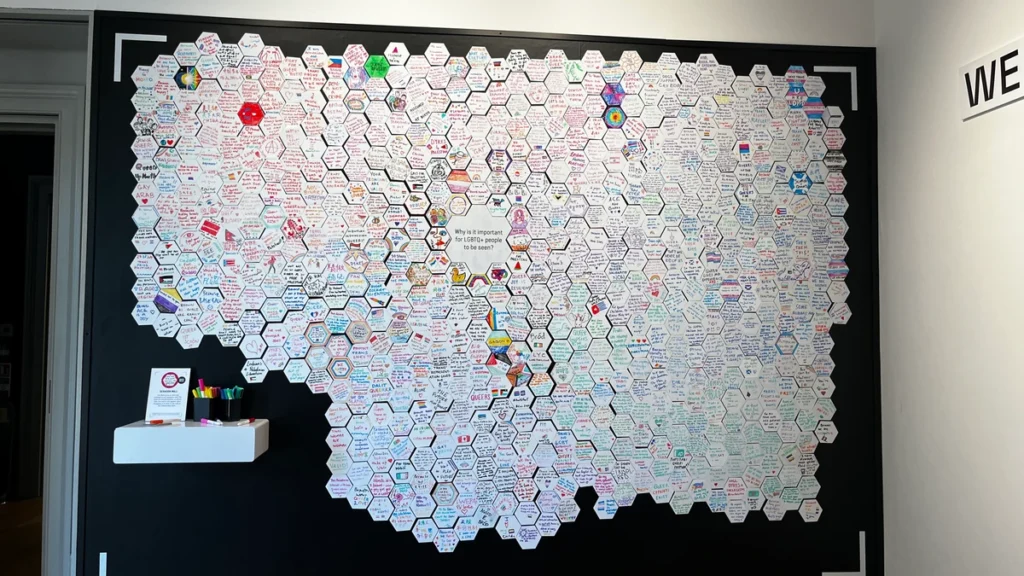
A museum that treats these as gallery subjects rather than footnotes is making an argument about what counts as heritage. That argument is the reason the visitor-feedback wall in the building asks people why it matters for LGBTQ+ people to be seen — a question the collection itself is trying to answer.
Thirteen Portraits Upstairs
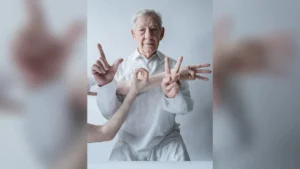
Running alongside the permanent displays is Trans Is Human, showing from 5 August to 29 November. It features thirteen portraits by the photographer Mariano Vivanco, produced by Jake and Hannah Graf, with support from East Side Studio, Allianz and Catherine Ahn.
Thirteen is a small number for an exhibition, and the framing the museum uses — celebrating the people beyond the narratives so often imposed upon them — indicates the intent. Portraiture at that scale asks a viewer to look at individuals rather than process a category, which is a different task from reading a statistic about a population.
It also sits deliberately apart from the news cycle. Trans lives in Britain have been discussed for several years primarily through legal and political argument, and a room of thirteen photographs is an implicit refusal of that framing.
A New Chair From This Month
Sir Nick Partridge takes over as Chair of the Board of Trustees from September, succeeding co-founder Ian Mehrtens.
Founder-to-successor transitions are the point at which new institutions either become permanent or quietly wind down. A museum that opened recently and is still establishing its funding base depends heavily on the people who willed it into existence, and the first handover tests whether the thing can run without them.
Entries are also open for the new-look 2026 Queer Britain Art Award, and the museum ran a Chosen Family Map with Skittles during Pride season. Both are the ordinary machinery of a working museum — an open call to artists, and a partnership that funds programming — which is itself a sign of an institution settling into a normal operating rhythm.
What the AIDS Quilt Panel Carries
AIDS Quilt 23 is the display least likely to be read quickly. Memorial quilt panels were made by friends, partners and families for people who died in the epidemic, each one hand-produced and each one naming a specific individual. They are textile objects rather than documents, and they were made by people with no expectation that a museum would ever hold them.
That changes how a visitor encounters the material. A panel is not an interpretation of a life written afterwards by a historian; it is an object made by someone who knew the person, in the immediate aftermath, using whatever materials were available. The information it carries about grief is first-hand in a way almost nothing else in a heritage collection is.
It also anchors the chronology of the other displays. The Black Lesbian and Gay Centre operated in a period shaped by the epidemic and by the political response to it. Club Kali emerged afterwards. Fashanu’s career ran through the same years. A quilt panel in the room supplies the context that lets a visitor read the rest of the gallery as connected rather than as separate topics.
Why a Building Matters More Than an Archive
Queer British history has never been short of documentation. What it lacked was a permanent public place to put it, with an address, opening hours and a physical space a person can walk into without explaining why.
That distinction matters more than it sounds. Material held in university archives or private collections is available in principle and inaccessible in practice to almost everyone. A gallery in King’s Cross that anyone can visit changes who the history is for.
It also changes what can be shown together. An archive stores the Fashanu papers in one place and the Club Kali flyers in another, catalogued separately and consulted by different researchers. A gallery puts them in the same room and lets a visitor notice they are part of one story.
Our recent report on GLAAD counting zero trans characters in 225 studio films covers the same question of visibility from the opposite direction — what happens when the record is not kept at all.
About The Author