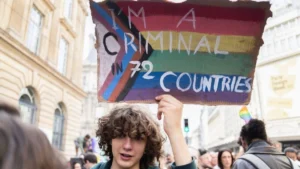

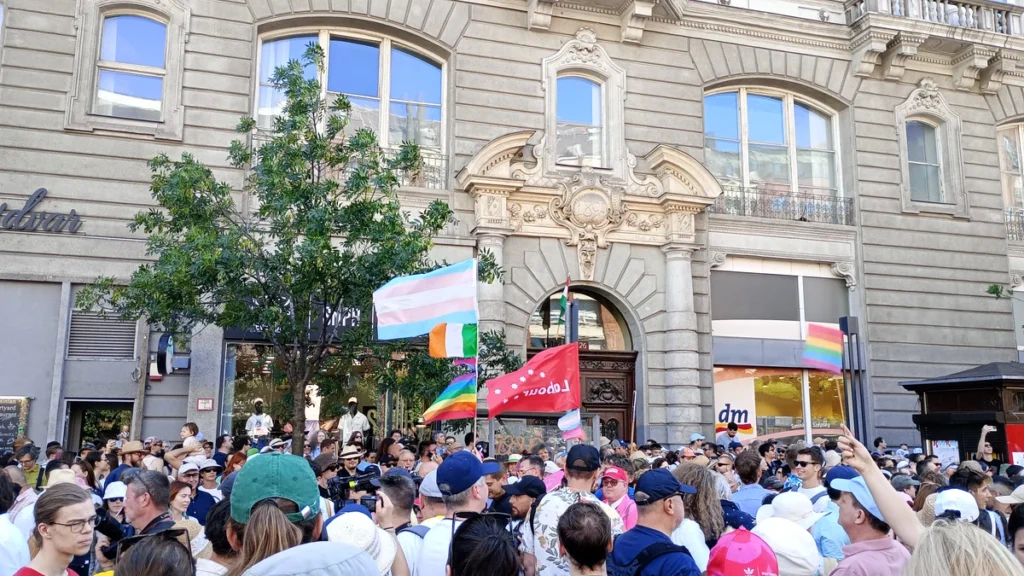
Marchers carry Pride and trans flags at Budapest Pride on 28 June 2025
Five years after Viktor Orbán’s government passed its so-called child protection law, Hungary has voted to take the anti-LGBTQ+ heart out of it. On 14 October the Hungarian parliament approved, by 139 votes to 51, a bill removing the anti-LGBTQ+ provisions from Act LXXIX of 2021, the law that grouped LGBTQ+ people with content children were supposedly being protected from.
The vote is the clearest sign yet of how quickly the country is changing under Prime Minister Péter Magyar, whose centre-right Tisza party ended Orbán’s rule in April. It comes alongside a promise to reopen adoption to same-sex couples, a restored Budapest Pride, and the release of €4.2 billion in frozen EU funds.
What the 2021 Law Actually Said
The wording was blunt. “It shall be forbidden to make accessible to persons who have not attained the age of 18 years advertisement that depicts sexuality in a gratuitous manner or that propagates or portrays divergence from self-identity corresponding to sex at birth, sex change or homosexuality,” the law stated, as quoted by the Washington Blade.
In practice it grouped homosexuality and gender change with gratuitous sexual content, and kept them away from anyone under 18. Reuters has described it as part of a wider set of measures under Orbán that banned materials in schools seen as promoting homosexuality or gender transition, alongside an end to legal gender change in personal documents.
The law drew international condemnation from the start. The European Commission took Hungary to court over it in 2022, and 16 EU member states joined the case. In April 2026 the EU Court of Justice ruled against it, finding that the rules restricting LGBTQ+ content violated European law.
A Change of Government Made the Vote Possible
None of this was conceivable a year ago. Orbán’s Fidesz-KDNP coalition governed Hungary for 16 years, and it was his government that built the legal architecture now being dismantled. In elections on 12 April, Magyar’s Tisza party won 138 of parliament’s 199 seats to Fidesz’s 55, according to LGBTQ Nation, and he took office in May.
Magyar did not campaign as an LGBTQ+ rights champion, but he did say he wanted Hungary to be a place “where no one is stigmatized for thinking differently than the majority, or loving differently than the majority”. He also campaigned on rebuilding Hungary’s relationship with the EU, which had frozen billions in funding over a range of rule-of-law concerns, the child protection law among them.
Since then the pace has been fast. The court ruling, the change of government and the parliamentary vote arrived within six months of each other, and each made the next easier. After the 14 October vote, the EU released €4.2 billion, roughly $4.67 billion, in funds it had frozen, the Washington Blade reported.
What the New Wording Says
The rewrite does not abolish protections for children; it changes what children are protected from. Under the new text, minors are shielded from material that can “seriously impair the child’s physical, intellectual, emotional, or moral development”, LGBTQ Nation reported, and all references to the portrayal and promotion of sexual and gender diversity are removed.
That distinction is the whole point. The 2021 law did not stop at schools and television. It also required sex education workers to register with the government, a measure aimed at preventing what the law called the promotion of the representation of specific sexual orientations. Taking LGBTQ+ identity out of the list of harms means teachers, broadcasters and advertisers no longer have to treat queer lives as something to hide from teenagers.
“We’ve Been Fighting This for Five Years”
For Hungarian activists, the vote closes a long chapter. “We are very happy that this got adopted,” Tamás Dombos of the Háttér Society, one of Hungary’s leading LGBTQ+ rights groups, told the BBC, in comments reported by the Washington Blade. “We’ve been fighting this so-called child protection law for five years. There have been problems with the bill submitted to parliament, but most of those problems have been fixed.”
That last sentence matters. Campaigners were not handed a perfect bill, they pushed for changes and got most of them. It is a reminder that rights are rarely restored in one gesture; they are negotiated clause by clause, even by a friendly government.
It also shows how long the work took: five years of opposition, most of them spent under the government that wrote the law.
Dombos has been clear that the job is not finished. “There is still a lot to do,” he said, as quoted by LGBTQ Nation. “Even if the government’s sole aim is to restore the legal status quo that existed before 2020, there are still a great many laws that would need to be amended… and we don’t know whether the government’s working on that.”
Adoption Rules Are Next
The next target is adoption. Since late 2020, single people in Hungary have needed approval from the minister for family affairs to adopt, according to Reuters. Because marriage is reserved for opposite-sex couples, that rule effectively ended adoption by gay and lesbian people, who had previously been able to adopt when one partner applied as a single parent.
Rights groups said the changes discriminated against same-sex couples and LGBTQ+ families, PinkNews reported. In September Magyar said they would go. “We can state unequivocally that we will change this system: it should not be the minister, a politician … who makes the decision in such cases,” he said, “but rather professionals capable of determining the conditions under which a given young child can achieve … a life that allows them to become a happy and harmonious member of society.”
No timetable was given for the adoption change. But the framing, that professionals rather than politicians should decide, takes the question out of ideology and puts it back into child welfare, which is where advocates have always argued it belongs.
Pride Is Back on Budapest’s Streets
The most visible change has already happened. In 2025 Orbán’s government passed a law banning Pride events and amended the constitution to prohibit public LGBTQ+ events. More than 100,000 people marched anyway at Budapest Pride on 28 June 2025.
This June the march went ahead without restrictions, and charges against Budapest’s mayor, Gergely Karácsony, for helping organise the 2025 event were dropped, the Washington Blade reported. A year after a banned parade came a legal one, and now the law that justified the crackdown is being rewritten.
What Is Still at Stake
The reversal is real, but it is not complete. Same-sex marriage has never been allowed in Hungary, although civil unions are recognised, and Reuters listed the end of legal gender change in personal documents among the Orbán-era measures still in place when it reported Magyar’s adoption pledge in September. That leaves trans Hungarians with some of the most still to win back.
The adoption reform still has to be written and passed, and the details of the October bill will matter in practice: how schools, broadcasters and advertisers interpret what is now allowed. Equality campaigns elsewhere show how much turns on the exact wording, as our explainer on what Virginia’s Question 2 would change about marriage set out.
For now, Hungary has moved from being a frequently cited example of anti-LGBTQ+ lawmaking in the European Union to a country actively undoing it. For the queer Hungarians who marched in 2025 when marching was illegal, that shift has come remarkably quickly.
About The Author