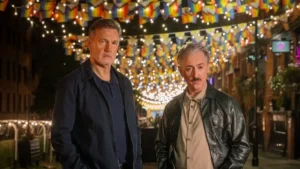

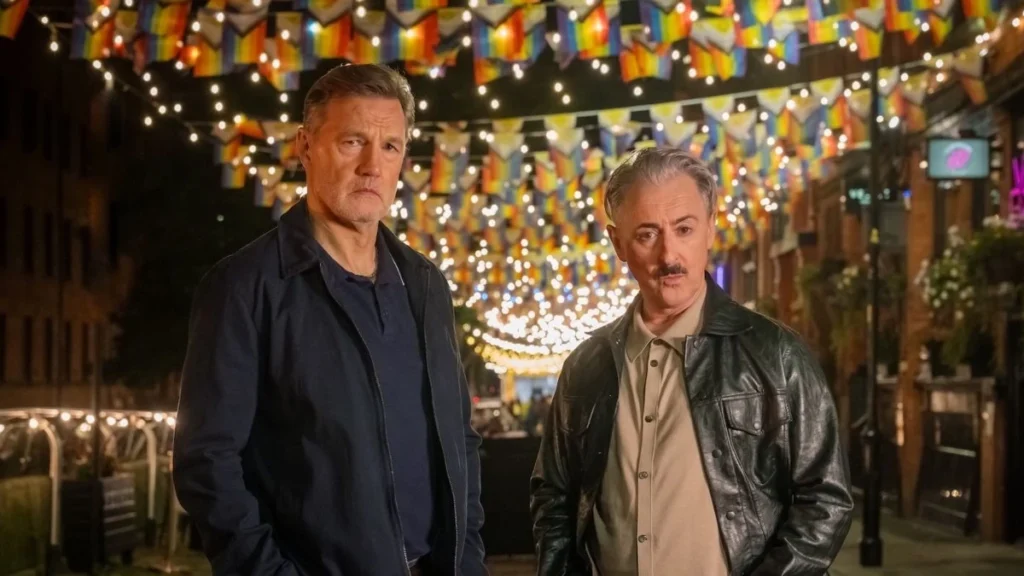
David Morrissey as Clive and Alan Cumming as Leo in Tip Toe.
“I used to walk into a room and just go, ‘Ta-da!'” says Melba, a Canal Street regular in eyeshadow and a bright red lip. Now, Melba admits, “I tiptoe. Just in case.” That exchange, quoted by The Hollywood Reporter, gives Russell T Davies’ new drama Tip Toe its name, and it is the sound of a community that remembers the years of celebration and can feel them slipping.
Tip Toe, a five-part series written and created by Davies, reached American viewers on Starz on October 2 after airing on Channel 4 in the UK over the summer. Alan Cumming plays Leo Struthers, who runs a bar in Manchester’s Gay Village, and David Morrissey plays Clive Goss, the neighbour on the other side of his wall. For Davies, whose Queer as Folk put the same streets on screen in 1999, Tip Toe is a return to familiar ground, with a very different mood.
A Bar in the Gay Village and a Neighbour Next Door
Leo and Clive “have lived next door to each other in Manchester for almost 15 years,” according to the official synopsis published by Variety when the series was announced. “But just as life should be settling down, the world around them is growing more tense. Words become weapons, opinions become radicalized, and gradually, two neighbors become deadly enemies”, in what the synopsis calls a “tense, suburban thriller”.
The first scene tells viewers where the story ends: Leo, dead, hanging from a lamppost outside his home. Each episode then winds back through the ten days that led there. According to TIME, both men are pushing 60 and both have hit rough patches. Clive, an electrician, is struggling to find enough work to support his family. Leo’s ex-husband, Curtis (Charlie Condou), has left him for a woman, and Leo is trying to keep Spit & Polish, the bar they used to run together, on its feet.
Their lives collide by accident. Chasing a one-night stand who has run off with his laptop, Leo locks himself out of his house in his underwear and has to knock on Clive’s door. The exchange of a spare key sets off what TheWrap calls “a truly unfortunate chain of events”, and Leo’s decision to hire Clive and his older son Saul (Joseph Evans) for some electrical work at the bar draws the two households closer still. Clive’s younger son, George (Jackson Connor), turns out to be a closeted gay teenager, and Leo becomes a reluctant confidant.
The Line That Gave the Series Its Name
Melba, played by Paul Rhys, is the first to sound the alarm. Melba has watched the mood shift and refuses to pretend otherwise. When Davies previewed a first clip at BFI Flare earlier this year, the scene had the two friends weighing up the return of bigotry. “Do I think it’s coming back?” Melba asks, in the clip described by Time Out. “It’s back.”
Leo is the optimist. He tells Melba the pendulum of public opinion will swing back, as it always has. The series is built on the gap between those two positions, and on a question Leo asks later that cuts to the heart of the last decade: “What if they see us and they still don’t like us?” For a generation that fought for visibility believing it would bring acceptance, that is the hardest thought in the drama. TIME frames it the same way, noting that the question of whether the visibility Leo’s generation won “has backfired, making them all easy targets, haunts the series.”
The Chosen Family Behind the Bar
Spit & Polish is where the show’s warmth lives. Leo, a gay man living with HIV, is “an almost parental figure to his young staff, which is composed primarily of trans women and a few young gay men,” TheWrap notes. Among them is Zee (Iz Hesketh), a trans bartender who, TIME writes, is calling herself Zee while she decides on a permanent name, and who has to dodge transphobic violence every day. At one point, Leo and the bar’s manager, Judy (Luyanda Unati Lewis-Nyawo), go with Zee to collect her belongings before her transphobic housemates see her. Safety in numbers is the community’s oldest tool, and the show treats it with respect.
The wider cast fills out the scene. Variety lists Shakeel Kimotho as Hanna, who also works at the bar, and Denise Welch as Diane, while The Hollywood Reporter identifies Dominic Holmes as the drag queen Regime. Leo’s best friend, Stephanie (Elizabeth Berrington), rescues him more than once, yet carries prejudices of her own about trans people and about how gay men see women. The Hollywood Reporter found it odd that her bigotry “is never meaningfully addressed”, but the choice underlines one of the drama’s sharper points: hostility does not only come from the house next door.
Alan Cumming and David Morrissey, Friends for 40 Years
The central pairing carries real history. “Russell T Davies and I have been trying to work together for over 20 years,” Cumming said when the series was announced. “Now, not only are we working together but doing so with one of my dearest, oldest friends, Dave Morrissey, and in a piece of work I think is so brilliant and prescient and necessary.” Morrissey, who has worked with Davies before, said Cumming “has been a great friend of mine for over 40 years but we’ve never had the chance to work together.”
Critics have singled out both performances. The Hollywood Reporter wrote that Cumming “positively crackles with charm and wit” as Leo, and is especially strong in his moments of tenderness with George, passing on the advice he never received growing up in the 1980s. Morrissey’s Clive is harder to watch by design. TIME calls him “an avatar for straight masculinity in crisis”, and TheWrap describes the performance as “an absolute master class”. Clive spends his nights watching hateful videos online, and every flicker of warmth towards Leo is shut down almost as soon as it appears.
Completing a Trilogy With It’s a Sin and Years & Years
TIME reads Tip Toe as the final part of a loose trilogy. Davies “raged against the homophobia of the early AIDS crisis” in It’s a Sin and “looked queasily ahead to a dystopian future” in Years & Years; Tip Toe “unites their themes”, the review argues, and its shared Manchester setting with Queer as Folk “underlines just how much that community’s outlook has changed in a quarter-century.” Collider draws the same line: Tip Toe, its review says, “is firmly grounded in the here and now, and is all the more brutal and terrifying for it.”
There is a striking footnote in Davies’ own telling of that history. At BFI Flare, he recalled that the original opening of Queer as Folk was meant to follow 15-year-old Nathan walking alone through Manchester, and that Channel 4 executives pushed back because it looked too much like a thriller, “like he’s going to get murdered,” Time Out reported. Twenty-seven years later, Davies has opened a Manchester drama with exactly the image those executives feared, and this time the fear is the point.
What the Critics Make of Tip Toe
The reviews agree on the power and argue about the volume. The Hollywood Reporter called the series “angry but empathetic, frank in its darkness but refusing to wallow in it.” TIME described it as “a harrowing cri de coeur about masculinity in crisis and queer liberation reversed,” while noting “scripty speechifying and a finale that strains believability.” Collider allowed that some viewers will find it too melodramatic or too preachy, and that in places it can be, but concluded that it is “one of the most urgent shows on TV this year, a rallying cry against the erosion of LGBTQ rights in Britain.”
That split is honest about what Davies is doing. Tip Toe is not interested in subtlety. Its characters say what they fear out loud, and its monologues are written for viewers who may not have noticed how quickly the ground has moved. For queer audiences who have noticed, the experience is closer to recognition than revelation.
How to Watch, and Why It Lands Now
Tip Toe premiered on Starz on Friday, October 2, at 9 p.m., The Hollywood Reporter reported, with Peter Hoar directing every episode. In the UK, the series was made for Channel 4. It is produced by Quay Street Productions, part of ITV Studios, which distributes the show internationally, with Davies, Cumming, Nicola Shindler and Hoar as executive producers, according to Variety.
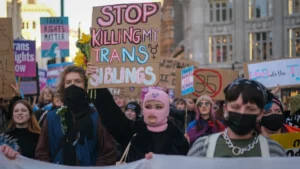
A note of care for viewers: the series depicts homophobic and transphobic hostility from its first scene, and its ending is as painful as that opening suggests. It also arrives while the political debate it dramatises is very much live in Britain, where queerpeople.news reported when the Lib Dems became the first big party to reject EHRC trans guidance.
What stays with you is not only the violence. It is the bar full of chosen family, the jokes traded across it and the friends who show up when someone needs to collect their things. Tip Toe asks what it costs to keep living that life out loud, and it never suggests the answer is to stop.
About The Author