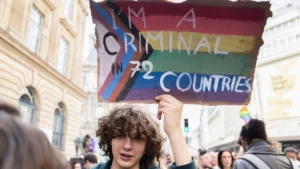


The NYC Pride March in 2026. The bill's sponsors argue the 1985 rules pushed part of queer New York's social life out of sight.
The regulation that emptied New York’s bathhouses was written in 1985, when there was no PrEP, no routine HIV testing and no effective treatment. It is still on the books. A bill introduced this month would finally take it off, and replace the New York bathhouse ban with something the state has never had: a licensing system.
State Senator Erik Bottcher and Assemblymember Tony Simone, both Manhattan Democrats, introduced the Public Health Modernization Act, S10673, in early August. It does two things. It directs the state Department of Health to repeal the 1985 regulations, and it gives the department 180 days to write new rules covering how adult saunas would be licensed and run.
What the 1985 Rule Actually Says
The detail matters more than the shorthand. As Time Out New York sets out, the 1985 state health regulation prohibited public baths from setting aside areas for sexual activity. It did not outlaw the buildings; it removed the thing that made them what they were.
New York City used those state rules the following year to close the city’s gay bathhouses. Four decades later the regulation has never been revisited, which means a rule drafted in the most frightening year of the AIDS crisis is still setting policy in a city where HIV medicine has been transformed several times over.
What the Bill Would Replace It With
The legislation deliberately does not write the operating rules itself. According to the sponsors’ announcement, the Department of Health would repeal the existing prohibition and then has 180 days to establish a public health framework governing licensing and operation.
Bottcher told The Advocate that the department is the right body to do it. “The Department of Health has tremendous expertise in this area,” he said. “They would establish both a licensing framework and public health standards, looking at best practices from around the country. That creates opportunities to provide HIV and STI prevention resources, connect people with testing and treatment, and ensure these facilities are operating safely.”
That is the practical argument for regulation over prohibition. A licensed venue can be inspected. It can host testing. It can be a place where prevention resources are handed to the people most likely to use them, rather than a place the health system has no relationship with at all.
Advocates make the same point from the opposite direction: bringing the businesses into a regulated system would allow regular inspections and stronger health oversight while making prevention resources easier to reach. Prohibition does not produce any of that. It produces an absence of records, an absence of inspections and an absence of any official contact with the people involved, which is a strange outcome for a rule that exists in the name of public health.
It is worth being precise about what the bill does not do. It does not authorise anything by itself, it does not set opening hours or capacity, and it does not write a single health standard. It hands all of that to the Department of Health and sets a clock. The New York bathhouse ban would end on the day the department completes the repeal; what replaces it would be whatever the department writes in the six months that follow.
Why the Sponsors Say the Science Moved
Bottcher’s framing is about the difference between an emergency and a permanent settlement. “Emergency measures from another era should not become permanent public policy,” he said in the announcement. “Actions taken at the height of the AIDS crisis are out of step with modern reality. The science has changed. Prevention has changed. Treatment has changed. It’s time for our laws to change too.”
Simone put it more bluntly. “The year is 2026, not 1986: evidence-based practices informed by the past 30 years of public health research make it clear we should repeal the ban on adult-use bathhouses and saunas,” he said. “We all know these places exist. By banning them, predominately queer New Yorkers are being forced into the shadows. It is time to repeal the ban on adult-use bathhouses and create a safe and regulated system to protect the health and wellbeing of New Yorkers.”
The prevention landscape he is pointing at is the one that has moved fastest of all. Long-acting PrEP in particular has produced results that would have been unimaginable when the regulation was written, as our report on a single HIV case across 2,452 patient-years laid out.
The Spaces New York Closed
It is easy to forget how central these venues were to queer social life before 1986, and how little they resembled the caricature. The Continental Baths, which opened in 1968 beneath the Ansonia Hotel on the Upper West Side, had a pool, saunas, a disco, private rooms and a cabaret. Bette Midler performed there with Barry Manilow.
Dr Demetre Daskalakis, chief medical officer at Callen-Lorde, made the community point in the sponsors’ announcement. “These spaces have long played an important role in fostering community, connection, and belonging, particularly within LGBTQ+ communities,” he said. “My own work in these venues has shown that they can also be powerful environments for health outreach and prevention. By bringing people together rather than pushing them into less visible settings, we create opportunities to build trust and deliver services that improve health outcomes.”
Charles King, president and chief executive of Housing Works, framed the closures as counterproductive. “Bottcher and Simone are to be commended for this important step forward in the AIDS response,” he said. “Koch’s actions drove sex venues underground, creating more risk especially for gay and bisexual men.”
Who Is Backing It
The support list is unusually broad for a bill of this kind, spanning clinical providers, housing and HIV services, advocacy groups and community institutions. Callen-Lorde, Housing Works, NEW Pride Agenda, Equality New York, the Queer Nightlife Community Center, The NYC LGBT Community Center, GLAAD, GMHC and the Jim Owles Liberal Democratic Club were all quoted in support when the bill was announced.
That breadth matters because it separates the proposal from a purely cultural argument. When the organisations that actually deliver HIV testing, treatment and housing services line up behind a repeal, the case being made is a public health one.
Minneapolis Went First
New York would not be leading here. Minneapolis repealed its own bathhouse ban, in place for close to four decades, earlier in 2026, and San Francisco has adopted regulations permitting saunas under public health standards.
Bottcher has leaned on exactly that comparison. Modern prevention tools “have fundamentally changed how we prevent HIV,” he told The Advocate. “Other cities have recognized that reality, and New York should as well.”
The Timeline Nobody Should Ignore
One piece of context keeps this in proportion. New York’s regular legislative session ended in June 2026, so the bill is not expected to be taken up until next year, and Time Out notes that the positions of legislative leaders and Governor Kathy Hochul are not yet clear.
In other words, this is the opening of a conversation rather than the end of one. What has changed is that the New York bathhouse ban is now a live legislative question with named sponsors, a bill number and a coalition behind it, after forty years in which it was simply the way things were. For a policy written in a year when nobody knew what would work, being argued about on the evidence is the point.
About The Author