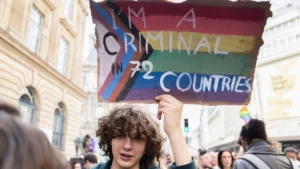

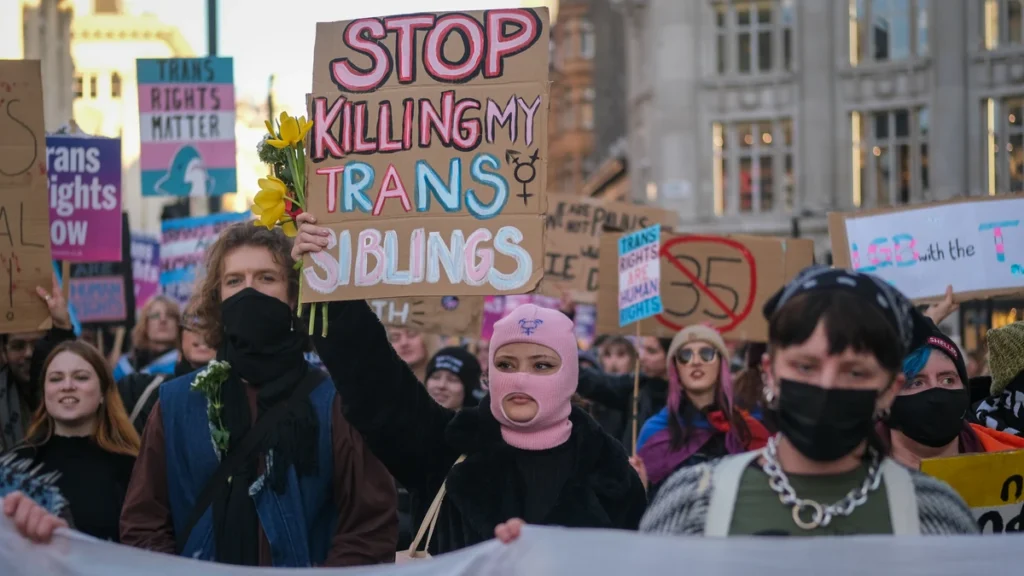
Trans rights campaigners marching in London in January 2023
On Sunday 21 September, in a conference hall in Brighton, Liberal Democrat members raised their hands for trans people. By a clear majority on a show of hands, they passed an emergency motion rejecting the EHRC trans guidance that has governed single-sex spaces since August, calling it “discriminatory and unworkable”. The vote makes the Lib Dems the first of the three largest parties at Westminster to formally call for a different approach, and party leader Ed Davey backed it.
For trans people who have spent the past year watching the rules on toilets, changing rooms and services tighten around them, it is the first time one of those parties has put a formal alternative on the record. It does not change the law. It does change who is arguing for what.
What the Motion Actually Says
The motion was brought by LGBT+ Liberal Democrats, the party’s LGBT+ campaigning organisation. Left Foot Forward reports that it expressed “concern” that the new guidance “bars trans people from facilities aligned with their lived gender”, and described the rules as “discriminatory” and “unworkable”.
Its asks are specific. It calls for the Equality and Human Rights Commission to issue a new code of practice that is “inclusive, workable and ensures everybody can safely access public facilities and providers are protected from legal risk”. It calls for a dedicated cross-party parliamentary committee “to review how the law should better protect trans people’s rights”. And, according to PinkNews, it argues that the existing code “places an undue burden on service providers”.
Attitude reports that the motion also states plainly that trans women are women, that trans men are men, and that the rights of women and the rights of trans people are not in competition. That last point was the thread running through most of the speeches in favour.
The Code It Wants Replaced
The guidance in question follows the Supreme Court’s ruling in April 2025 that “sex” in the Equality Act 2010 means biological sex. The EHRC then updated its statutory code of practice for services, public functions and associations. According to Personnel Today, the EHRC published the updated code on 14 July after a public consultation, and it came into force on 5 August.
Under the code, service providers can lawfully run separate or single-sex services where doing so is “a proportionate means of achieving a legitimate aim”. Attitude explains that this means single-sex spaces may, in certain circumstances, be based on biological sex, so trans women and trans men may be excluded from facilities that match their gender. The code asks organisations to consider alternatives for trans people, such as a separate “third space” or gender-neutral facilities. Campaigners argue that this effectively treats trans people as a third gender, and PinkNews notes that the guidance has been criticised because gender-neutral facilities are not always available.
The code does not apply directly to employers, although Personnel Today notes that it will affect employers that also provide services to the public. Its reach is the everyday world of services, public functions and associations, which is where most single-sex facilities are found.
Voices From the Conference Floor
The debate in Brighton was not one-sided, and both camps were heard. Lucas North, chair of LGBT+ Liberal Democrats, who proposed the motion, told delegates: “The rights of women and the rights of trans people do not have to be placed on opposite sides of a manufactured culture war.”
Rebecca Jones, a trans woman, spoke about what the rules feel like from the inside. “I’m tired of being a culture war prop,” she said. “You now fear using public spaces. You fear anyone that looks at you too much in case they hate trans people enough that they put you at risk.”
Opponents argued the party was heading in the wrong direction. Councillor Mark Johnston told the hall that “realism means accepting the Supreme Court determination last year is unassailable”. Zoe Hollowood, chair of Liberal Voice for Women, accused the party of taking a “sledgehammer to women’s rights” and warned that it risked dragging the party back into the culture wars. “If we pass this motion, we are telling women we think they are second-class citizens,” she said. The motion passed anyway, easily, on a show of hands.
Davey’s position mattered. Before the vote he told BBC Radio 4’s Today programme that he supported the motion, and he described the EHRC guidance as not “fit for purpose”. PinkNews notes that this is a change from 2025, when the party’s initial reaction to the Supreme Court ruling dismayed some members and campaigners, and Davey stayed silent on the post-ruling guidance, drawing criticism from LGBT+ Lib Dems at the time.
What the EHRC Says the Code Is For
The Commission has defended the code as a practical guide rather than new policy. Its chair, Dr Mary-Ann Stephenson, said the guidance would “help services across the country comply with the Equality Act, protecting service users from discrimination and harassment while reducing the risk of the provider being subject to litigation”, according to Personnel Today. She said consultations in 2024 and 2025 drew views from more than 50,000 respondents.
On BBC Radio 4, Stephenson said the code covers all protected characteristics, not only sex and gender. “It doesn’t make new law; what it does is explain what the law is and how service providers can follow the law,” she said. She also stressed that trans people should be protected from discrimination and should not be left in a situation where there are no services they can use.
That gap between the stated intention and the lived experience is exactly where the Lib Dem motion aims its criticism. Supporters argue that the practical effect of the code is to leave trans people with fewer places they can safely go, whatever its authors intended.
A Growing Challenge to the Guidance
The Lib Dems are not the only ones pushing back. Personnel Today reports that 167 MPs backed an early day motion calling for the code to be disapproved because of its impact on trans people, and that the Good Law Project is supporting a trans person and a trans-inclusive organisation as claimants in a legal challenge, having sent a pre-action protocol letter to the government and the EHRC.
“It’s difficult to believe just how far backwards our government has gone on trans human rights,” said Jess O’Thomson, trans rights lead at the Good Law Project, in comments reported by Personnel Today. What the Lib Dems add is a formal party position. Campaigners and lawyers can challenge the code, but only parties can promise to change it, and the Lib Dems are now the first of the big three to say they would.
What Happens Next
A conference motion sets party policy; it does not change the law or the code, which remains in force. Stephenson’s point stands for now: service providers are expected to follow the guidance. Change would need the EHRC to reissue it, Parliament to act, or the courts to rule, which is why the Good Law Project’s challenge is being watched closely.
The cross-party committee the motion calls for would need support well beyond the Lib Dem benches to exist. For trans people and the organisations that serve them, the more immediate value of Sunday’s vote is visibility: a major party has now said, in writing, that trans women are women, trans men are men, and that the current rules are not working.
The debate over trans rights is playing out far beyond Westminster, and in some places the direction of travel is very different. Our recent report on how Cuba stopped asking for surgery photographs to change a gender marker looked at one country easing the path for trans people. In Britain, the question after Brighton is whether any other party follows the Lib Dems, and how long the code stays as it is.
About The Author