
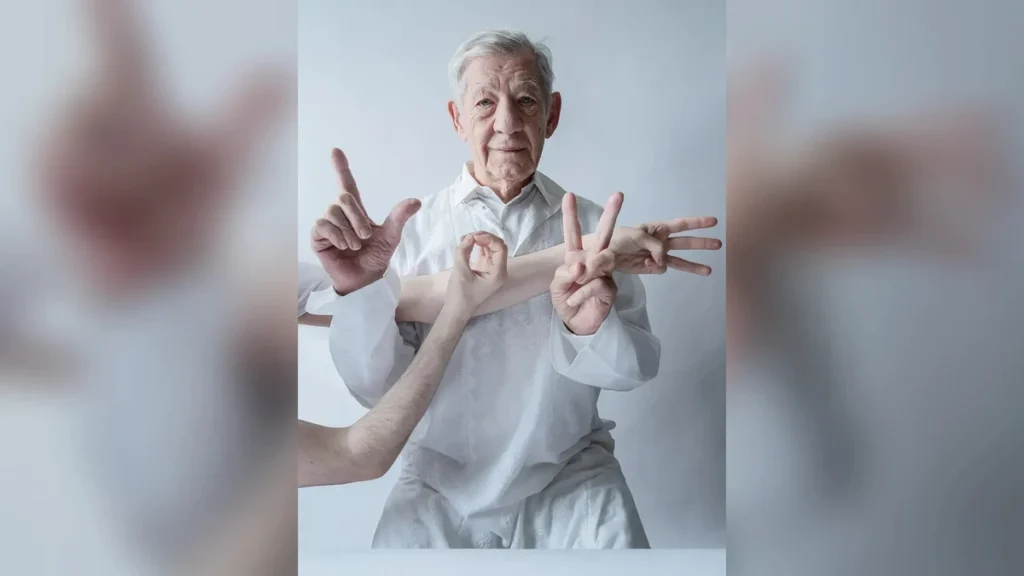
Tim Walker has described his new exhibition as the moment he finally placed himself in the queer world with confidence and went to greet the friends who live there. “Fairyland is me saying you are not alone,” he said. “I want visitors to the exhibition to remember that your difference is your power.” That exhibition, Tim Walker’s Fairyland: Love and Legends, opens at the National Portrait Gallery in London on 9 October and runs until 7 February 2027, according to Amateur Photographer.
It is built from 250 specially made portraits of queer people and their allies, photographed over five years in Britain and beyond. The sitters run from founders of the Gay Liberation Front to nightlife performers, nurses, activists and some of the most recognisable faces in the community, and together they cover more than fifty years of queer activism, love and life.
Five Years With a Community He Calls His Own
Walker came to prominence in the 1990s with fantastical, elaborately staged photography rooted in his love of fairy tales. He found photography while working at the Cecil Beaton archive, assisted Richard Avedon in New York, and shot his first story for British Vogue at 25, Amateur Photographer notes. His work has run in Vogue, Vanity Fair, W and i-D, he has published seven books, and the Victoria and Albert Museum staged his immersive survey Wonderful Things.
Artlyst describes Fairyland as a decisive shift. The fashion context falls away, and what replaces it is five years of sustained engagement with a community Walker has described as his own. The title is part of the point. The exhibition reclaims the word “fairy”, pushing back against homophobia and transphobia with his own blend of wit, joy and sensitivity.
The show is curated by Susanna Brown and designed by Shona Heath, Walker’s longtime collaborator. Costumes and props appear in the rooms as well as in the photographs, alongside written notes and behind-the-scenes material on how the pictures were made.
A Queeristocracy in the Style of the Tudors
The exhibition opens with the people who argued for the right to love in the 1970s and 1980s. Founding members of the Gay Liberation Front and Stonewall, among them Olivette Cole-Wilson, Andrew Lumsden, Lisa Power and Tom Robinson, are photographed as what Walker calls his own queeristocracy, in a style drawn from the Tudor court portraits of Hans Holbein the Younger and Nicholas Hilliard. Artlyst makes the case that placing these figures in a tradition of portraiture that long excluded them is itself an argument.
Walker invited each sitter to bring a meaningful object. The author Jane Cholmeley holds the original shop sign from Silver Moon Women’s Bookshop, founded in 1984. The photographer Sunil Gupta holds his camera. The filmmaker Isaac Julien holds a conch shell, a motif from his 1989 film Looking for Langston. Artlyst calls these objects evidence of lives and histories rather than props.
Changemakers including Peter Tatchell, Caroline Paige, Ted Brown and Gilli Salvat are shown against plain white backgrounds, a nod to Avedon, alongside storytellers who made queer life visible in the late twentieth century, such as James Ivory and Sarah Waters. Walker also photographed people working for a better future now, among them Liz Carr, Shon Faye, Francis Lee, Lady Phyll, E-J Scott and Kae Tempest.
The titles of the images released so far show how often Walker reaches back into art history. Andrew Lumsden, who died in 2023, is pictured after Nicholas Hilliard. Alex Gorey and Matías Montes are photographed after the Greek painter Yannis Tsarouchis. The film director Francis Lee appears in a picture called Ode to Edward Carpenter, and Olivette Cole-Wilson poses with a blackbird. The dates on those captions run from Ben Whishaw in Crystal Prism in 2020 to the Cole-Wilson portrait in 2025, which gives a sense of how long the project has been in the making.
Bringing the Disco to the Ward
A substantial section is given to the HIV/AIDS crisis of the 1980s. Nurses and healthcare professionals who developed effective treatments hang alongside the musicians who soundtracked the era, including Marc Almond, Holly Johnson and Jimmy Somerville. Walker has said he wanted to bring the disco to the ward: to honour the people who fought for proper care, and to celebrate music that kept booming despite the fear of mortality and discrimination.
One of the images released ahead of the opening shows Jill Nalder holding a photograph of Dursley McLinden, who died in 1995. It is a quiet counterpart to the glamour elsewhere, and a reminder that much of the community’s history lives in family albums and chosen family. Readers who want to see how that history is being collected will find a companion in Queer Britain in King’s Cross, where AIDS Quilt 23 is among the museum’s new displays.
The Rebel Dykes at the Centre of the Show
At the heart of the exhibition is a room of large-scale portraits of the Rebel Dykes, the post-punk collective whose campaigns spanned nuclear disarmament, environmentalism, sex-positive feminism and HIV solidarity. The photographs take their visual cue from Karlheinz Weinberger’s pictures of 1960s biker gangs.
A short film plays alongside them, in which the women reflect on community and on the campaigns that shaped them. Placing the collective in the middle room gives them a central position in the story rather than a footnote.
Fashion, Drag and Faces the World Knows
The second half turns to fashion, make-up and performance, the territories where queer culture has long done some of its most transformative work. The portraits include the designers Jean Paul Gaultier and Michaela Stark, drag performers Paul O’Grady, David Hoyle and Midgitte Bardot, the personalities Alan Carr and Sue Perkins, and the actors Ncuti Gatwa, Hunter Schafer, Fiona Shaw and Ben Whishaw. Musicians include Björk, Lady Gaga, Boy George, Frank Ocean and Chappell Roan.
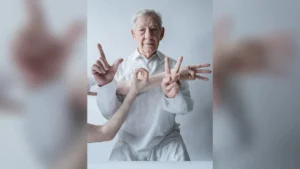
Some of the scenes are pure Walker theatre. Paul O’Grady, who died in 2023, and Julian Clary appear as the Glitter Queens, with Harry Browse, Rae and Liam Elias as the Glitter Boys. Ian McKellen appears in a portrait titled Love, and Miriam Margolyes in one called Clapham Cream Teas. Collages such as Fairyland Parade and Harry Keita as Delphinium Fairy were built by photographing sitters individually, arranging them with plants and insects, and photographing the result again.
The exhibition ends with a room of staged erotic scenes that rework fairy tales and nursery rhymes through a queer lens. Walker has said that the greatest lesson from the activists, storytellers and performers in Fairyland was how essential eroticism and humour are, a place where people can desire, be desired and be whoever they want to be.
Planning a Visit
Tim Walker’s Fairyland: Love and Legends is at the National Portrait Gallery, St Martin’s Place, from 9 October 2026 to 7 February 2027, as confirmed by Amateur Photographer, Artlyst and HENI. Amateur Photographer lists tickets at £23 off-peak from Monday to Thursday and £25 at peak times from Friday to Sunday, or £25.50 and £27.50 with a donation. The gallery is open daily from 10.30 to 18.00, and until 21.00 on Fridays and Saturdays.
A 320-page catalogue, priced at £35, includes an extended interview between Walker and Brown and essays on the history of activism, the AIDS crisis, love and relationships. Dazed reports that the accompanying book features writing by Travis Alabanza, Shon Faye, Russell T Davies, Lisa Power and Joelle Taylor, and Amateur Photographer lists Brown among the contributors too.
For a photographer long associated with fashion fantasy, the most striking thing about Fairyland may be how much of it is about other people’s lives. Five years, 250 portraits and a room for every era of the community’s history add up to a family portrait, made by someone who now counts himself part of the family.
About The Author