
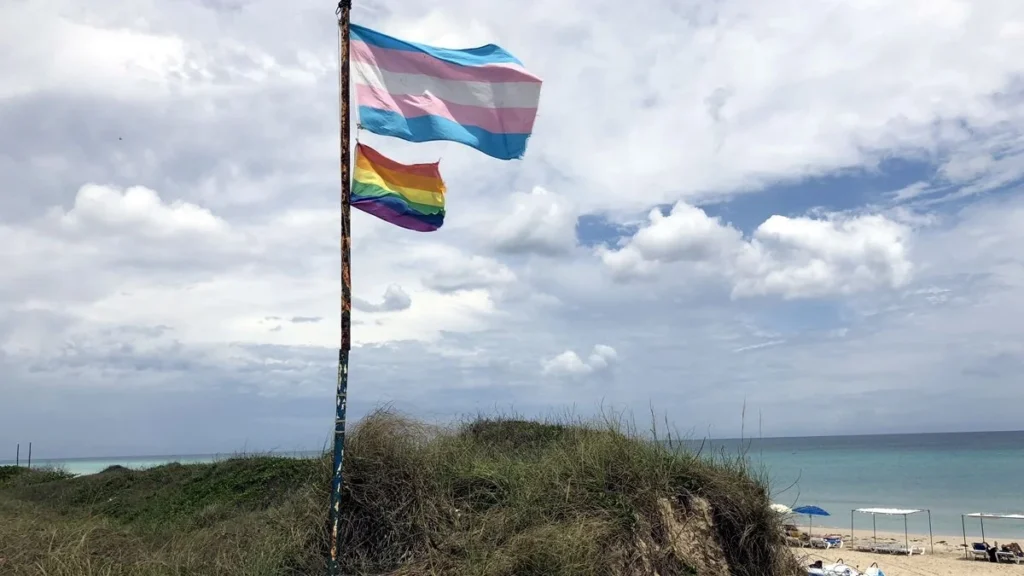
A transgender Pride flag and a rainbow flag fly over Mi Cayito, a beach east of Havana.
Until this month, a trans person in Cuba who wanted the sex on their birth certificate corrected had to prove they had undergone genital surgery, and prove it in four separate ways. A summary of their clinical records. A descriptive medical account of the operation, with emphasis on its irreversibility. A document signed by the National Center for Sex Education confirming the intervention. And photographs taken before and after.
From 17 September, that file is replaced by a request. Cuba’s new Civil Registry Law lets an adult change their gender marker at the registry itself, without surgery, without a court and without a certificate showing they have no criminal record.
What the Old Process Actually Required
The requirement being retired dates from 2008 and ran through the courts rather than the registry. A petitioner filed with the Civil Section of a local court, which then passed the request to the National Commission for Comprehensive Attention to Trans People alongside medical certification that surgery had taken place.
The four evidentiary items above were what the court needed to see. Read as a list, they describe a process built on the assumption that a person’s account of themselves is not sufficient evidence, and that the state should look at photographs of their body before agreeing with them.
Cuba’s health system has covered gender-affirming surgery and hormone treatment free of charge since 2008, under Resolution No. 126, which made the surgical requirement less obviously exclusionary than it would be elsewhere. Activists critical of the National Center for Sex Education have nevertheless said access to those procedures is limited in practice, so the requirement still functioned as a gate.
Name change had already been separated from surgery. Since 2022, trans people in Cuba have been able to change their name by self-determination, after the Ministry of Justice repealed the instruction that had tied a name change to genital surgery. What arrives this month extends that logic from the name to the gender marker.
The Article That Replaces It
Under the new law, an adult’s voluntary rectification of registered sex is handled directly at the Civil Registry. The file consists of a personal request, a report from the multidisciplinary team coordinated by the National Center for Sex Education, and a birth certificate.
That is still an administrative process with a clinical component rather than pure self-declaration on the Argentine or Maltese model. But the decision moves out of a courtroom and into a registry office, and the surgical precondition disappears entirely.
The change applies to birth certificates, government-issued identity cards and other legal documents, which is the part that matters day to day. A mismatched ID is not an abstraction; it is a problem at a bank counter, a clinic reception and a police checkpoint.
What It Changes for People Waiting
Victoria Escribano, a 21-year-old Cuban trans woman who sells handicrafts, had put off opening a bank account for years because she wanted her name and her registered gender to match how she lives. She told the Thomson Reuters Foundation’s Context that the law changes the calculation.
“For people like me, having a legal basis that protects us, either when doing some paperwork or just stepping into a place, it’s a pretty big advance,” she said. Ever Luis Valdespino, who works as an orchestra production assistant, told the same outlet he hoped the law would remove the bureaucratic obstacles that had made the process close to impossible.
Both descriptions point at the same thing. The barrier people describe is rarely a single refusal; it is the accumulated cost of every routine transaction becoming an interrogation.
More Than the Gender Marker
The Civil Registry Law is broader than this one provision. According to CiberCuba’s report on the parliamentary vote, it also legislates on the freedom to choose one’s own name, on changing names and surnames, on the order of surnames, and it recognises the intersex condition of a person at birth.
Its stated guiding principles are legality, legal certainty, immediacy, universality, free provision, administrative efficiency and the protection of personal data. It incorporates a gender perspective, attention to people in vulnerable situations and respect for the progressive autonomy of children and adolescents. Justice Minister Oscar Manuel Silvera Martínez has said the law gives the country a modern civil registry, and noted the institution operates 334 connected offices.
Francisco Rodríguez Cruz, an activist and journalist who works with the National Center for Sex Education, wrote that the amendments carry important guarantees and rights for trans and intersex people and for LGBTI citizens generally. He noted the law establishes equality before the law without discrimination on grounds including sexual orientation and gender identity, as set out in the 2019 constitution, and that it opens the way to legal recognition for same-sex parents and for trans and intersex children.
Where This Sits Regionally
Cuba is joining a group rather than leading one. Argentina, Uruguay, Germany and Malta already allow trans people to change their name and legal gender without surgery, and the International Lesbian, Gay, Bisexual, Trans and Intersex Association for Latin America and the Caribbean responded to the vote by saying Cuba advances towards equality.
The national context has moved in steps rather than in one motion. The 2019 constitution that Cubans approved in a referendum did not include marriage rights for same-sex couples; a 2022 referendum endorsed a family code that opened the way to marriage equality. The registry law is the third of those steps, and the first that reaches identity documents.
Reforms of this shape usually arrive as the removal of an old restriction rather than the creation of a new right, which is a pattern this publication has followed elsewhere, including a bill that would end a four-decade ban in New York. The mechanism is the same: the rule stops being enforced before anyone agrees on what it was for.
The Part That Has Not Changed
None of this operates in a vacuum. The Cuban constitution bans discrimination on the basis of sexual orientation and gender identity, and Cuban authorities also routinely harass and detain activists who publicly criticise the government.
The case usually cited is Brenda Díaz, a trans woman with HIV who took part in an anti-government protest in Artemisa Province in 2021. A Havana court sentenced her to 14 years, and independent journalists reported that she was made to serve the sentence in a men’s prison. She was released in January under a deal brokered with Vatican involvement.
The organisation coordinating the new law’s clinical reports is itself directed by Mariela Castro, a member of the National Assembly and the daughter of former president Raúl Castro. In 2013 she voted against adding sexual orientation to Cuba’s labour code, on the grounds that it did not also include gender identity. The Washington Blade’s report on the vote sets out that context, including the newspaper’s own experience of being refused entry to the country in 2019 to cover events marking the International Day Against Homophobia, Transphobia and Biphobia.
So the honest reading of 17 September is narrow and real at the same time. A specific, humiliating evidentiary requirement is being removed, and thousands of people will be able to hold documents that match them without first proving what has been done to their bodies. What that does not settle is whether the same state will treat those people fairly once the paperwork is correct. The record of the old requirement ends on 16 September; the rest is unfinished.
About The Author