
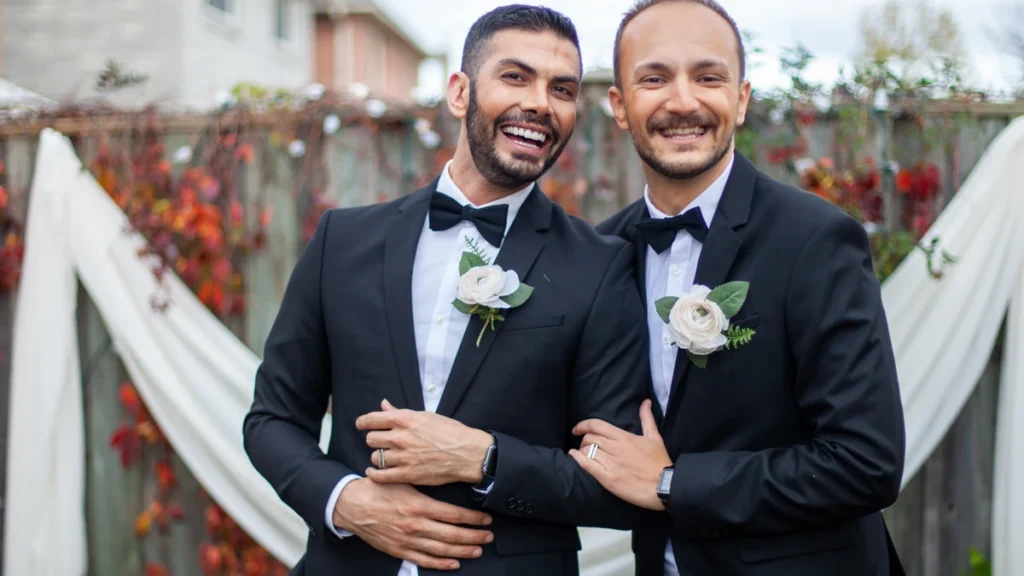
Two grooms celebrate their wedding.
In just over two decades, marriage equality has gone from unthinkable to law in 38 countries. When the Netherlands opened marriage to same-sex couples in 2001, it stood alone; today, roughly one in five countries recognises the right, and the map keeps changing. Here is where marriage equality stands in 2026, the milestone that reshaped Asia, and the places that could be next.
Thirty-Eight Countries and Counting
As of 2026, same-sex marriage is legally performed and recognised in 38 countries: Andorra, Argentina, Australia, Austria, Belgium, Brazil, Canada, Chile, Colombia, Costa Rica, Cuba, Denmark, Ecuador, Estonia, Finland, France, Germany, Greece, Iceland, Ireland, Liechtenstein, Luxembourg, Malta, Mexico, the Netherlands, New Zealand, Norway, Portugal, Slovenia, South Africa, Spain, Sweden, Switzerland, Taiwan, Thailand, the United Kingdom, the United States and Uruguay. Between them they span every inhabited continent, a spread that would have seemed impossible a generation ago, as trackers like World Population Review document.
Thailand’s Historic Milestone
The most significant recent addition is Thailand, where same-sex marriage became legal on 23 January 2025. Thailand was the first country in Southeast Asia and the second in Asia after Taiwan to recognise marriage equality, becoming the 38th country in the world to do so. The response was overwhelming: according to the Ministry of Interior, more than 1,754 same-sex couples married on the very first day, around 650 of them in Bangkok. The United Nations in Thailand hailed it as a landmark not just for the country but for the whole region.
Why It Matters Beyond the Ceremony
Marriage equality is about far more than weddings. Legal marriage brings inheritance rights, next-of-kin recognition in hospitals, immigration and adoption rights, tax and pension protections, and the simple dignity of having a relationship recognised by the state. For many couples it is the difference between being legal strangers and being a family in the eyes of the law. That is why each new country matters so much, and why the campaigners who win these battles often spend years, sometimes decades, doing so.
Who Could Be Next
Momentum has not stopped. Courts and parliaments in several countries, particularly across Latin America, Asia and parts of Europe, are weighing cases and bills that could extend marriage equality further, and public support has trended upward in much of the world, as the Pew Research Center has tracked over time. Progress is not guaranteed and it is rarely a straight line, but the direction of travel over 25 years is unmistakable. From two grooms in Amsterdam in 2001 to 1,754 couples in Bangkok in a single day, marriage equality has become one of the defining human-rights advances of the century, and one worth celebrating even as the work continues.
About The Author