
Every summer, one professional sports league in the United States looks less like an exception and more like a blueprint. Queer visibility in the WNBA has reached a point in 2026 that would have been unthinkable a decade ago: openly LGBTQ+ athletes are not a scattered few but a defining share of the rosters, and coming out has quietly shifted from a headline to a normal part of the league’s fabric. For a competition still fighting for the pay and coverage it deserves, that culture of openness has become one of its most powerful signatures, and one of the clearest reasons a new generation of fans has fallen for the sport.
A League Where Coming Out Became the Norm
In most of elite sport, an out athlete is still treated as news. In the WNBA, the opposite is closer to the truth. Publications that track this have watched the count of openly LGBTQ+ players climb year on year, and the running joke among fans, that a WNBA arena is one of the safest and most joyfully queer rooms in America, has become something close to a mission statement. Players describe locker rooms where being out is unremarkable, and where the freedom to simply exist has become part of the competitive culture rather than a distraction from it.
That normalisation matters far beyond the hardwood. For young LGBTQ+ fans, seeing a starting five that includes married couples, engaged teammates and openly queer superstars is a form of representation no advertising campaign can manufacture. It is visibility earned through excellence, and it arrives without the caveats and hesitations that still surround coming out in most men’s leagues. In the WNBA, an athlete’s sexuality is simply one more fact about a professional at the top of her craft.
The Numbers Behind a Record 2026 Season
The scale is what makes 2026 remarkable. By Autostraddle’s 2026 count, a record 52 out gay, lesbian, bisexual and queer players are on WNBA rosters, roughly a quarter of the league’s playing spots. That is up from 46 the previous season and just 15 when the same outlet first began tracking the figure. No other major professional league in the country comes close to that proportion.
Other trackers put the number a touch lower, in the region of 50, but the direction is not in dispute. As reporting on the season notes, the total keeps growing, and players increasingly describe the league as a genuine safe space and themselves as visible role models. Queer visibility in the WNBA is no longer a subplot; it is a headline statistic, and one that fans track with the same enthusiasm they bring to scoring averages.
The contrast with the rest of American sport sharpens the point. Across the four biggest men’s leagues, openly gay active players remain vanishingly rare, and each coming-out is still treated as a landmark event. The WNBA has effectively inverted that dynamic. Here, an out player is ordinary and a closeted culture would be the anomaly, which is precisely why the league has become a reference point for what acceptance looks like when it is allowed to become routine rather than exceptional.
The Stars Carrying Queer Visibility on Court
What gives the numbers weight is that they include the league’s biggest names. Breanna Stewart, one of the finest players of her generation and married to former professional Marta Xargay, anchors a New York Liberty roster that also features 2024 Finals MVP Jonquel Jones. In Phoenix, veterans Alyssa Thomas and DeWanna Bonner have played as an engaged couple, part of a Mercury core stacked with openly queer talent, including All-Star Kahleah Copper.
The pattern repeats across the league. In Las Vegas, the Aces field openly queer standouts such as four-time champion point guard Chelsea Gray, Jackie Young and Jewell Loyd. Relationships that once would have been carefully hidden are now simply part of the league’s story, from Young and DiJonai Carrington to Saniya Rivers and Marina Mabrey. It carries history with it, too. Brittney Griner, who in 2013 became the first openly gay college player drafted into the WNBA, remains a landmark figure whose early openness helped make the current moment possible.
When the best players on the floor are also visibly, unremarkably out, representation stops being a gesture and becomes the everyday reality of the sport. Fans do not have to search for a role model on the margins of the roster; they can find one at the centre of the offence.
A Draft Class That Made History
The pipeline is just as striking as the pros. The 2026 draft saw Azzi Fudd and Olivia Miles selected at the very top of the board, and their arrival was celebrated as another milestone for queer representation in the game. Fudd, whose relationship with 2025 Rookie of the Year Paige Bueckers is public and widely supported by fans, entered the league as one of its most watched newcomers.
That continuity, from college stars to rookies to established veterans, is what makes the WNBA’s culture durable. Each incoming class arrives into a league where being out is expected to be a non-issue, and that expectation lowers the cost of honesty for the next generation of athletes. The rookies of 2026 grew up watching openly gay superstars win titles; they enter a locker room where that is simply how the league looks.
Player-Led Media and Pride on the Court
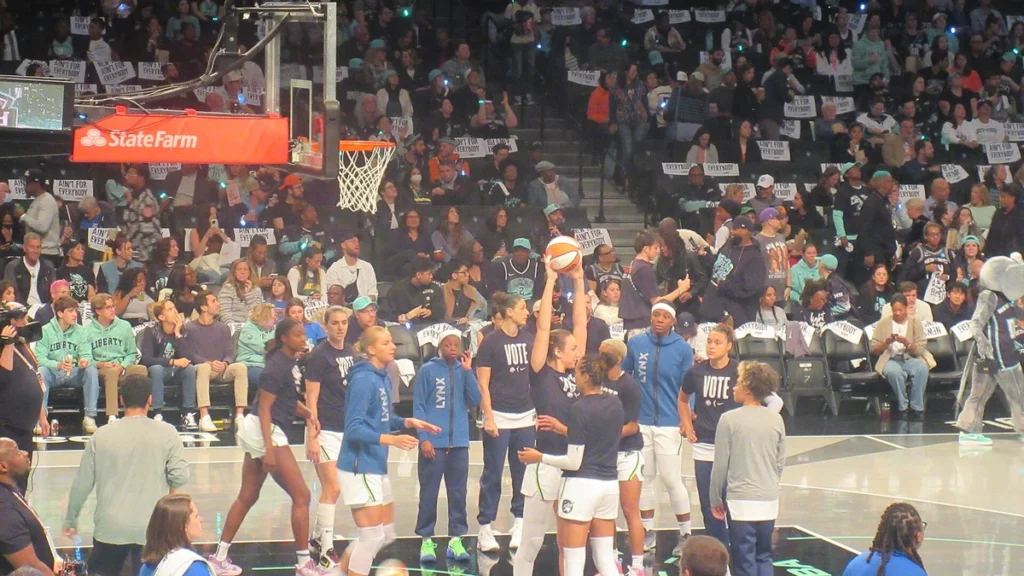
None of this happened by accident. The WNBA’s fanbase has long skewed queer, and the league has increasingly met that community halfway, through Pride nights, player-led activism and a media culture that treats players as full people. Minnesota’s Courtney Williams has become an unlikely broadcasting star through her freewheeling streaming show, turning pre-game rituals and locker-room banter into must-watch content for a fanbase fluent in the league’s in-jokes. Games have become cultural events as much as sporting ones.
There is a lesson here for other leagues still nervous about the subject. The WNBA did not lose fans by embracing its queer identity; it deepened its bond with them. Authenticity, it turns out, is good business as well as good culture, and the league’s willingness to let its players be themselves has become inseparable from its brand and its rising attendance.
Expansion, and the Visibility Still to Come
The league is growing, with new franchises in Toronto and Portland adding roster spots and fresh markets. More teams mean more players, more stories and, on current trends, more openly LGBTQ+ athletes stepping onto the biggest stage women’s basketball has ever had. Visibility, once won, tends to compound, and each new market inherits a culture in which being out is already the norm rather than a battle to be fought again.
That expansion also lands at a tense political moment for queer and trans people, which makes the league’s steady openness feel less like celebrity and more like advocacy. For anyone tracking the wider picture, from legislation to everyday acceptance, it sits alongside the trends we covered in our state of LGBTQ+ rights in 2026. The WNBA’s contribution is simple and profound: a nationally televised, sold-out reminder that queer people belong at the very top of their field, and that when they get there, everyone watching gets a little more room to be themselves.
About The Author